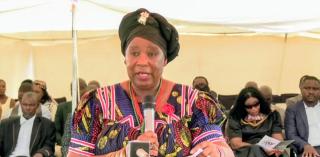
WINDHOEK, 27 July 2026 – Delegates from the African Union and experts met in Windhoek on July 27-31 for the Sixth Ordinary Session of the AU Technical Committee on Social Development to enhance social safety nets and resilient labour markets in Africa. (Photo by: Uakutura Kambaekua) NAMPA.
WINDHOEK, 27 July 2026 – Delegates from the African Union, policy experts, and government ministers convened in Windhoek on Monday for a three-day event, the Sixth Ordinary Session of the AU Specialised Technical Committee on Social Development, Labour and Employment. (Photo by: Uakutura Kambaekua) NAMPA.
GOBABIS, 27 July 2026 - Omaheke Governor Pijoo Nganate pictured with Deputy Executive Director and Chief Registrar in the Ministry of Home Affairs, Immigration, Safety and Security during a courtesy visit by the Ministry as part of the eID awareness campaign in Omaheke. (Photo: Molly Weyulu) NAMPA
WINDHOEK, 27 July 2026 – African Union delegates are attending a week-long indaba from Monday to Friday, the Sixth Ordinary Session of the AU Specialised Technical Committee on Social Development, Labour and Employment (STC-SDLE 6) in Windhoek. (Photo by: Uakutura Kambaekua) NAMPA.
WINDHOEK, 27 July 2026 – Namibia's Justice and Labour Relations Executive Director, Ben Nangombe, speaking at the Sixth Ordinary Session of the African Union Specialised Technical Committee on Social Development, Labour and Employment (STC-SDLE 6) in Windhoek on Monday. (Photo by: Uakutura Kambaekua) NAMPA.
WINDHOEK, 27 July 2026 - Delegates from the African Union, policy experts, and government ministers gathered in Windhoek on Monday for the Sixth Ordinary Session of the AU Specialised Technical Committee on Social Development, Labour, and Employment (STC-SDLE 6). (Photo by: Uakutura Kambaekua) NAMPA.
OPUWO, 27 July 2026 - The welcome sign at the entrance to Opuwo. (Photo: Kaviveterue Virere) NAMPA
OPUWO, 27 July 2026 - Opuwo Mayor Kasipo Kakondo discusses ongoing infrastructure projects in the town. (Photo: Kaviveterue Virere) NAMPA
(260727) -- KUWAIT CITY, July 27, 2026 (Xinhua) -- This photo taken on July 26, 2026 shows a scene at the signing ceremony in Hawalli Governorate, Kuwait. China State Construction Engineering Corporation Ltd. (CSCEC) on Sunday signed the contract for the North Kabd Wastewater Treatment Plant and Related Works Project at Bayan Palace in Kuwait's Hawalli Governorate. The North Kabd Wastewater project reflects high-quality Belt and Road cooperation between China and Kuwait in infrastructure development and ecological and environmental protection. (Photo by Ma Yu/Xinhua)
(260727) -- BEIJING, July 27, 2026 (Xinhua) -- Visitors walk through the Zhengyangmen Gate in Beijing, capital of China, July 27, 2026. Marking the second anniversary of the successful inscription of the Beijing Central Axis on the UNESCO World Heritage List, heritage sites along the central axis, such as the Palace Museum, Zhengyangmen Gate, and Altar of the God of Agriculture, also referred to as the Xiannongtan Temple, were opened to the public, and some sites launched new exhibitions on Monday. Stretching 7.8 kilometers from Yongding Gate in the south to the Drum and Bell Towers in the north, the Beijing Central Axis was constructed based on ancient architectural philosophies to create an ideal layout for a capital city. The Central Axis can be traced back to the early Yuan Dynasty (1271-1368), and its length was extended in the Ming and Qing dynasties. (Xinhua/Chen Zhonghao)
(260727) -- BEIJING, July 27, 2026 (Xinhua) -- People kick a shuttlecock at a square connecting the Drum and Bell Towers in Beijing, capital of China, July 27, 2026. Marking the second anniversary of the successful inscription of the Beijing Central Axis on the UNESCO World Heritage List, heritage sites along the central axis, such as the Palace Museum, Zhengyangmen Gate, and Altar of the God of Agriculture, also referred to as the Xiannongtan Temple, were opened to the public, and some sites launched new exhibitions on Monday. Stretching 7.8 kilometers from Yongding Gate in the south to the Drum and Bell Towers in the north, the Beijing Central Axis was constructed based on ancient architectural philosophies to create an ideal layout for a capital city. The Central Axis can be traced back to the early Yuan Dynasty (1271-1368), and its length was extended in the Ming and Qing dynasties. (Xinhua/Xie Han)
(260727) -- BEIJING, July 27, 2026 (Xinhua) -- A visitor takes photos of the Zhengyangmen Archery Tower on the Zhengyangmen Gate in Beijing, capital of China, July 27, 2026. Marking the second anniversary of the successful inscription of the Beijing Central Axis on the UNESCO World Heritage List, heritage sites along the central axis, such as the Palace Museum, Zhengyangmen Gate, and Altar of the God of Agriculture, also referred to as the Xiannongtan Temple, were opened to the public, and some sites launched new exhibitions on Monday. Stretching 7.8 kilometers from Yongding Gate in the south to the Drum and Bell Towers in the north, the Beijing Central Axis was constructed based on ancient architectural philosophies to create an ideal layout for a capital city. The Central Axis can be traced back to the early Yuan Dynasty (1271-1368), and its length was extended in the Ming and Qing dynasties. (Xinhua/Chen Zhonghao)
(260727) -- BEIJING, July 27, 2026 (Xinhua) -- People visit the Palace Museum in Beijing, capital of China, July 27, 2026. Marking the second anniversary of the successful inscription of the Beijing Central Axis on the UNESCO World Heritage List, heritage sites along the central axis, such as the Palace Museum, Zhengyangmen Gate, and Altar of the God of Agriculture, also referred to as the Xiannongtan Temple, were opened to the public, and some sites launched new exhibitions on Monday. Stretching 7.8 kilometers from Yongding Gate in the south to the Drum and Bell Towers in the north, the Beijing Central Axis was constructed based on ancient architectural philosophies to create an ideal layout for a capital city. The Central Axis can be traced back to the early Yuan Dynasty (1271-1368), and its length was extended in the Ming and Qing dynasties. (Xinhua/Li Xin)
(260727) -- BEIJING, July 27, 2026 (Xinhua) -- This photo taken on July 27, 2026 shows a view of the Beijing Central Axis seen from the Drum Tower in Beijing, capital of China. Marking the second anniversary of the successful inscription of the Beijing Central Axis on the UNESCO World Heritage List, heritage sites along the central axis, such as the Palace Museum, Zhengyangmen Gate, and Altar of the God of Agriculture, also referred to as the Xiannongtan Temple, were opened to the public, and some sites launched new exhibitions on Monday. Stretching 7.8 kilometers from Yongding Gate in the south to the Drum and Bell Towers in the north, the Beijing Central Axis was constructed based on ancient architectural philosophies to create an ideal layout for a capital city. The Central Axis can be traced back to the early Yuan Dynasty (1271-1368), and its length was extended in the Ming and Qing dynasties. (Xinhua/Xie Han)